






Static Method Python: A Practical Guide for Developers
A Static Method Python is a method that belongs to a class but does not require access to the instance of that class or the class itself. In simple words, a static method is a function placed inside...

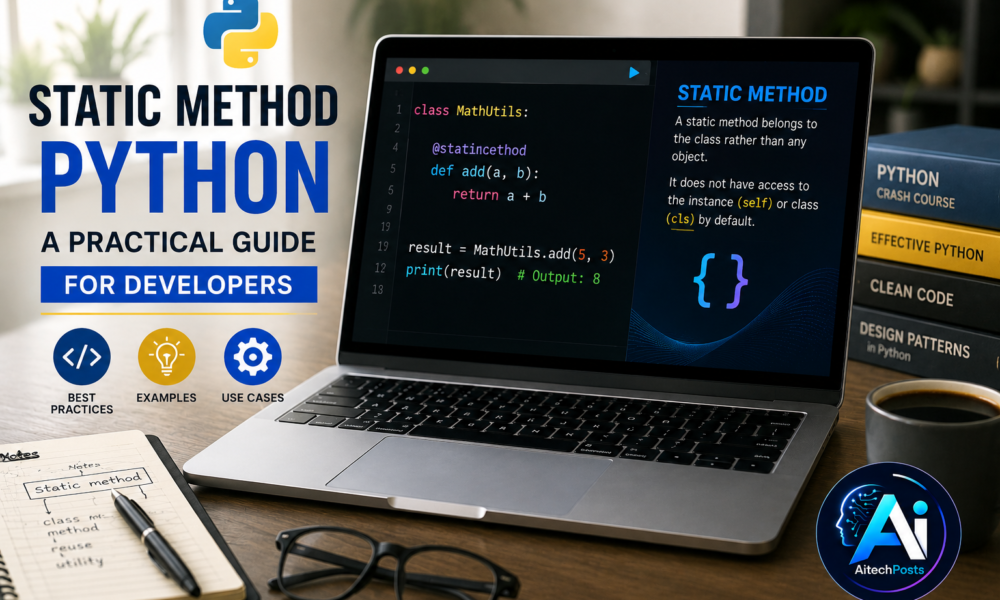
A Static Method Python is a method that belongs to a class but does not require access to the instance of that class or the class itself.
Table Of Content
- Instance Method
- Static Method
- Class Method
- Static Method
- 1. Better Code Organization
- 2. No Need to Create Objects
- 3. Improved Code Readability
- 4. Easy Testing
- 5. Reusable Functionality
- 1. Utility Operations
- 2. Data Validation
- 3. Mathematical Calculations
- 4. Formatting and Conversion
- Web Applications
- E-commerce Applications
- Banking Applications
- Data Science Projects
- 1. Using Static Methods Everywhere
- 2. Creating Static Methods Without Purpose
- 3. Ignoring Other Method Types
- Keep Methods Focused
- Use Meaningful Names
- Avoid Unnecessary Complexity
- Choose the Right Method Type
- Q1: What is Static Method Python?
- Q2: Why do developers use static methods?
- Q3: Can a static method access object data?
- Q4: Are static methods faster than normal methods?
- Q5: Should every helper function be a static method?
In simple words, a static method is a function placed inside a class because it is related to that class, but it works independently.
Normally, methods inside a Python class work with object information. For example, if a class represents a customer, an ordinary method may need customer details like name, age, or account information.
However, some functions do not need any information from the object. They only perform a specific task using the information provided to them.
These types of functions are commonly created as static methods.
For example, imagine a class related to a shopping application. A function that calculates a discount percentage does not need information about a specific customer or product. It only needs the price and discount value. Such functionality can be created as a static method.
The main purpose of a static method is to keep related functionality organized while avoiding unnecessary dependence on object data.
Why Are Static Methods Used in Python?
In Python development, organization and readability are very important. As applications become larger, managing hundreds or thousands of functions can become difficult.
Static methods help developers keep related functions together.
For example, a developer working on a payment system may have different operations like:
-
Calculating taxes
-
Validating payment details
-
Converting currency values
-
Formatting payment information
Some of these operations may not require actual payment object data. Instead of creating separate functions everywhere, developers can keep them inside a payment-related class as static methods.
The major reasons developers use Static Method Python include:
-
Better code organization
-
Improved readability
-
Reusable functionality
-
No requirement for object creation
-
Clear separation of independent operations
Static methods are especially useful in large software projects where maintaining clean architecture is important.
How Does Static Method Python Work?
A static method works differently from a normal method because Python does not automatically provide object-related information to it.
In regular methods, Python provides information about the object that is calling the method. This allows the method to access and modify object data.
However, static methods work independently. They only use the information given directly to them.
This makes static methods similar to normal functions, but their location inside a class shows that they are related to that class.
For example, a utility function that converts temperature values can exist inside a temperature-related class as a static method because it belongs conceptually to temperature operations.
The method does not need to know anything about a specific temperature object. It only performs a conversion task.
Static Method Python vs Instance Method
One of the most important differences developers need to understand is the difference between static methods and instance methods.
Instance Method
An instance method is the most common type of method used in Python classes.
It works with a specific object and can access information stored inside that object.
For example, if you create a customer class, an instance method can access:
-
Customer name
-
Customer ID
-
Account details
-
Personal information
Instance methods are useful when the behavior depends on a particular object.
Static Method
A static method does not depend on any specific object.
It does not need customer details, product information, or any other object-related data.
It simply performs a task based on the information provided.
The main difference is:
-
Instance methods work with object-specific information.
-
Static methods work independently.
A simple way to remember this difference:
If a method needs object data, use an instance method. If it does not need object data, consider using a static method.
Static Method Python vs Class Method
Python also provides another type of method called a class method.
Although static methods and class methods may look similar, they serve different purposes.
Class Method
A class method works with information related to the class itself.
It can access class-level data and is useful when the operation depends on the class rather than a specific object.
For example, if a company class stores the company name as a class-level value, a class method can access that information.
Static Method
A static method does not require class-level information.
It performs an independent operation without depending on the class or object.
The difference can be understood like this:
-
Instance method → Works with object information.
-
Class method → Works with class information.
-
Static method → Works independently.
Choosing the correct method type helps developers create cleaner and more understandable applications.
Benefits of Using Static Method Python
Using static methods provides several advantages for developers.
1. Better Code Organization
One of the biggest advantages of static methods is improved organization.
Instead of keeping related functions separately, developers can place them inside the appropriate class.
This makes projects easier to understand and maintain.
For example, all validation-related functions can remain inside a validation class, while all calculation-related functions can stay inside a calculation class.
2. No Need to Create Objects
A major benefit of static methods is that they can be used without creating an object.
This is useful when a function does not require object information.
Developers can directly access the functionality whenever needed without unnecessary object creation.
3. Improved Code Readability
When developers see a static method inside a class, they immediately understand that the method does not depend on object data.
This makes the code easier for other developers to read and understand.
Good readability is especially important when multiple developers work on the same project.
4. Easy Testing
Static methods are usually easier to test because they work independently.
Since they do not rely on changing object states, developers can test them using different inputs and check the results.
This makes debugging and maintenance easier.
5. Reusable Functionality
Static methods encourage developers to create focused functions that can be reused in different parts of an application.
A well-designed static method can perform a specific task without depending on unnecessary information.
When Should Developers Use Static Method Python?
Developers should use static methods when a function belongs logically to a class but does not require object or class information.
Some common situations include:
1. Utility Operations
Many utility functions are good candidates for static methods.
Examples include:
-
Calculations
-
Data conversions
-
Formatting operations
-
Small helper functions
These operations usually do not need information from an object.
2. Data Validation
Static methods are commonly used for validation tasks.
Examples:
-
Checking email format
-
Validating phone numbers
-
Checking password rules
-
Verifying input values
Validation functions often work independently, making static methods a suitable choice.
3. Mathematical Calculations
Many mathematical operations do not depend on object information.
Examples:
-
Percentage calculations
-
Unit conversions
-
Formula calculations
-
Measurement conversions
Static methods help keep such operations organized.
4. Formatting and Conversion
Applications often need functions that convert or format information.
Examples:
-
Date formatting
-
Currency conversion
-
Text formatting
-
Data transformation
These tasks can often be handled effectively using static methods.
Real-World Uses of Static Method Python
Static methods are used in many types of software applications.
Web Applications
In web development, static methods can help with:
-
Data validation
-
Processing user input
-
Formatting responses
-
Creating helper functions
They allow developers to organize supporting operations without creating unnecessary objects.
E-commerce Applications
Online shopping platforms use many independent calculations.
Examples include:
-
Discount calculation
-
Tax calculation
-
Price formatting
-
Product data validation
Static methods can handle these operations efficiently.
Banking Applications
Banking software often includes calculations and validation tasks.
Examples:
-
Interest calculation
-
Transaction validation
-
Currency conversion
Many of these operations do not require customer object information.
Data Science Projects
In data-related projects, static methods can help with:
-
Data cleaning
-
Data transformation
-
Mathematical operations
-
Formatting results
They help keep analytical operations organized.
Common Mistakes When Using Static Methods
Although static methods are useful, developers often make some common mistakes.
1. Using Static Methods Everywhere
Not every function should become a static method.
If a function needs information from an object, an instance method is usually the better choice.
Overusing static methods can make the design confusing.
2. Creating Static Methods Without Purpose
A static method should have a logical connection with the class.
Creating a class only to store random functions is usually not good design.
Sometimes a normal function is a better option.
3. Ignoring Other Method Types
Developers should understand when to use:
-
Instance methods
-
Class methods
-
Static methods
Choosing the wrong type can make code harder to maintain.
Best Practices for Static Method Python
To use static methods effectively, developers should follow some important practices.
Keep Methods Focused
A static method should perform one clear task.
Avoid creating large methods that handle multiple responsibilities.
Use Meaningful Names
The method name should clearly explain what the function does.
Clear naming improves code readability.
Avoid Unnecessary Complexity
If a simple function can solve the problem, there is no need to force it into a class.
Use static methods when they provide a real organizational benefit.
Choose the Right Method Type
Before creating a method, ask:
-
Does it need object information?
-
Does it need class information?
-
Does it work independently?
The answer will help determine whether you need an instance method, class method, or static method.
Frequently Asked Questions About Static Method Python
Q1: What is Static Method Python?
A: Static Method Python refers to a method inside a class that does not depend on object or class information. It works independently and is created using the static method concept in Python.
Q2: Why do developers use static methods?
A: Developers use static methods to organize related functionality inside classes without requiring object creation or access to object data.
Q3: Can a static method access object data?
A: No. Static methods cannot directly access object data because they do not receive object information automatically.
Q4: Are static methods faster than normal methods?
A: Performance is not the main reason for using static methods. They are mainly used for better organization, readability, and design.
Q5: Should every helper function be a static method?
A: No. Developers should use static methods only when the function logically belongs to a class. Otherwise, a regular function may be a better option.
Conclusion
Understanding Static Method Python is an important skill for developers working with object-oriented programming. Static methods provide a simple way to organize independent functions inside classes without depending on object or class information.
They are useful for:
-
Utility operations
-
Data validation
-
Calculations
-
Formatting tasks
-
Conversion operations
However, developers should use static methods carefully. A method should become static only when it does not require object or class data.
By choosing the right method type and following good programming practices, developers can create cleaner, more maintainable, and better-structured Python applications.
A proper understanding of Static Method Python helps developers write professional-level Python code and build applications that are easier to manage and scale.









No Comment! Be the first one.