






Best AI Tools for Students: Boost Learning and Productivity
Best AI Tools for Students! Artificial Intelligence (AI) is transforming the way students learn, study, and manage academic responsibilities. From organizing notes and improving writing skills to...

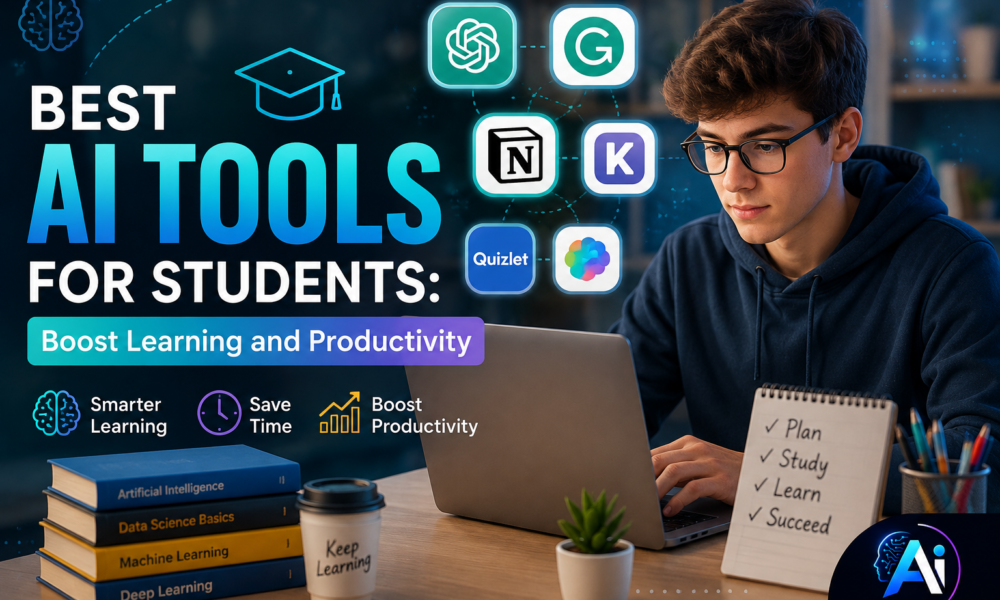
Best AI Tools for Students! Artificial Intelligence (AI) is transforming the way students learn, study, and manage academic responsibilities. From organizing notes and improving writing skills to solving complex problems and preparing for exams, AI-powered platforms are helping learners become more productive and efficient.
Table Of Content
- 1. Personalized Learning Experience
- 2. Improved Time Management
- 3. Better Research and Information Access
- 4. Enhanced Creativity and Problem Solving
- 1. ChatGPT – AI Learning Assistant for Students
- How Students Can Use ChatGPT
- Benefits of Grammarly for Students
- Student Uses of Google Gemini
- Features of Notion AI
- How Quizlet Helps Students
- Benefits of Perplexity AI
- 1. Learning Goals
- 2. Subject Requirements
- 3. Accuracy and Reliability
- 4. Privacy and Security
- 5. Ease of Use
- Faster Note Creation
- Better Study Planning
- Improved Writing Quality
- Efficient Exam Preparation
- Reduced Repetitive Work
The best AI tools for students are not designed to replace traditional learning methods. Instead, they act as smart assistants that support research, creativity, problem-solving, and personalized learning. Whether you are a school student, college learner, researcher, or someone preparing for competitive exams, AI tools can help you save time and improve your overall study experience.
With hundreds of AI applications available today, choosing the right tools can be challenging. Some platforms focus on writing assistance, while others help with mathematics, language learning, note-taking, coding, research, and productivity. Understanding which tools match your learning style is the key to using AI effectively.
In this guide, we will explore the best AI tools for students, their features, benefits, and how they can help learners boost productivity and achieve better academic results.
Why Students Should Use AI Tools for Learning
Modern education requires students to manage multiple tasks at the same time. They need to attend classes, complete assignments, prepare presentations, conduct research, and revise for exams. AI tools can simplify many of these activities by providing quick assistance and personalized support.
Here are some major reasons why students are adopting AI technology:
1. Personalized Learning Experience
Every student learns differently. Some understand concepts through examples, while others prefer visual explanations or step-by-step guidance.
AI-powered learning tools analyze user input and provide customized explanations based on individual needs. Students can ask questions, request simpler explanations, or practice topics according to their learning level.
2. Improved Time Management
Managing academic workload is one of the biggest challenges for students. AI productivity tools help create schedules, organize tasks, summarize information, and automate repetitive activities.
By reducing time spent on administrative work, students can focus more on understanding concepts and developing skills.
3. Better Research and Information Access
Research projects often require students to collect information from multiple sources. AI research assistants can help summarize articles, identify important points, and organize information faster.
However, students should always verify facts from reliable sources before using AI-generated information in academic work.
4. Enhanced Creativity and Problem Solving
AI tools encourage students to explore new ideas and approaches. They can help generate brainstorming ideas, explain difficult concepts, suggest improvements, and provide alternative perspectives.
Best AI Tools for Students in 2026
The following are some of the most useful AI platforms that can help students improve learning, productivity, and academic performance.
1. ChatGPT – AI Learning Assistant for Students
OpenAI developed ChatGPT, one of the most popular AI assistants used by students worldwide.
ChatGPT can act as a virtual tutor by explaining difficult topics, answering questions, creating study plans, generating practice questions, and helping students improve writing skills.
How Students Can Use ChatGPT:
- Understand complex academic concepts
- Generate study notes and summaries
- Practice interview and exam questions
- Improve essays and assignments
- Learn programming concepts
- Create revision schedules
For example, a student struggling with a physics topic can ask ChatGPT for a simple explanation, real-life examples, and practice problems.
The biggest advantage of ChatGPT is its flexibility. It can support students across different subjects, including science, mathematics, languages, business, and technology.
2. Grammarly – AI Writing Assistant
Writing assignments, essays, and research papers requires strong grammar, clarity, and organization. Grammarly uses AI technology to help students improve their writing quality.
It identifies grammar mistakes, suggests better sentence structures, improves readability, and helps maintain the right writing tone.
Benefits of Grammarly for Students:
- Correct spelling and grammar errors
- Improve sentence clarity
- Enhance vocabulary choices
- Check writing style
- Make academic writing more professional
Students can use Grammarly when preparing reports, applications, presentations, and research documents.
3. Google Gemini – AI Research and Study Support
Google developed Gemini as an AI assistant that helps users find information, analyze content, and generate ideas.
For students, Gemini can be useful for researching topics, understanding concepts, summarizing information, and exploring different perspectives.
Student Uses of Google Gemini:
- Research academic topics
- Summarize long documents
- Generate learning ideas
- Explain difficult concepts
- Assist with creative projects
Its connection with Google’s ecosystem makes it useful for students who already use Google Workspace applications.
4. Notion AI – Smart Note-Taking and Organization
Taking organized notes is essential for academic success. Notion AI combines note-taking features with artificial intelligence to help students manage information efficiently.
Students can use it to create study notes, summarize lectures, organize assignments, and manage academic projects.
Features of Notion AI:
- Automatic note summaries
- Task management
- Study planning
- Content organization
- Idea generation
For students handling multiple subjects, Notion AI can become a digital workspace where they store notes, deadlines, and learning resources.
5. Quizlet AI – AI-Powered Exam Preparation
Memorization plays an important role in many subjects. Quizlet uses AI features to create flashcards, practice tests, and learning activities.
Students can use Quizlet AI to prepare for exams more effectively by practicing important concepts repeatedly.
How Quizlet Helps Students:
- Creates digital flashcards
- Generates practice questions
- Supports active recall learning
- Helps with vocabulary building
- Tracks learning progress
This makes it especially useful for language learners, medical students, and exam preparation.
6. Perplexity AI – AI Search and Research Tool
Perplexity AI combines search capabilities with artificial intelligence to provide detailed answers with sources.
Students can use it as a research assistant when exploring academic topics or collecting information for projects.
Benefits of Perplexity AI:
- Quick research assistance
- Source-based answers
- Topic explanations
- Academic exploration
- Faster information discovery
Unlike traditional search engines, AI research tools can provide summarized explanations instead of only displaying website links.
7. Wolfram Alpha – AI Problem Solver for Mathematics and Science
Mathematics and science students often need help solving complex equations and understanding calculations. Wolfram Alpha is a computational AI platform designed for advanced problem-solving.
It can help students with:
- Algebra problems
- Calculus calculations
- Statistics
- Scientific explanations
- Data analysis
While students should not depend entirely on AI for solving problems, these tools can help them understand the steps behind solutions.
8. Canva AI – AI Design Tool for Student Projects
Presentations and visual projects are common parts of modern education. Canva AI helps students create professional designs without advanced graphic design skills.
Students can use Canva AI for:
- Presentation creation
- Infographics
- Posters
- Visual study materials
- Project designs
Good visual communication can make academic presentations more engaging and easier to understand.
9. GitHub Copilot – AI Coding Assistant
For computer science and programming students, GitHub Copilot can improve coding productivity.
It provides coding suggestions, explains programming concepts, and helps developers write code faster.
Students can use it for:
- Learning programming languages
- Debugging errors
- Understanding code structures
- Building projects
AI coding assistants are especially helpful for beginners who need guidance while practicing programming.
10. Otter.ai – AI Transcription Tool
Students often struggle to take complete notes during lectures. Otter.ai uses AI-powered transcription to convert spoken words into written notes.
It can help students:
- Record lectures
- Create transcripts
- Review important discussions
- Search lecture notes quickly
This allows learners to focus more on understanding lessons rather than writing every word.
How to Choose the Best AI Tools for Students
With many AI platforms available, students should choose tools based on their academic requirements.
Consider these factors:
1. Learning Goals
Identify what you want help with. A student preparing for exams may need AI flashcards and study planners, while a writer may need grammar and editing tools.
2. Subject Requirements
Different AI tools specialize in different areas. Mathematics students may benefit from problem-solving platforms, while researchers may prefer AI research assistants.
3. Accuracy and Reliability
AI tools can sometimes generate incorrect information. Always verify important facts, especially when using AI for academic assignments or research.
4. Privacy and Security
Students should understand how AI platforms handle personal information. Avoid sharing sensitive academic or personal data unnecessarily.
5. Ease of Use
The best AI tools for students should have simple interfaces and features that match the student’s learning style.
How AI Tools Improve Student Productivity
AI technology can improve productivity in several practical ways.
Faster Note Creation
AI can summarize lectures, articles, and textbooks, helping students review important information quickly.
Better Study Planning
AI assistants can create customized study schedules based on deadlines and learning goals.
Improved Writing Quality
Writing assistants help students communicate ideas clearly and professionally.
Efficient Exam Preparation
AI-powered quizzes and flashcards help students practice and identify weak areas.
Reduced Repetitive Work
Tasks such as formatting documents, organizing information, and creating outlines can be completed faster with AI support.
Responsible Use of AI in Education
Although AI provides many advantages, students should use these tools responsibly.
AI should be treated as a learning assistant rather than a shortcut for avoiding work. Students should focus on understanding concepts instead of simply copying AI-generated answers.
Good practices include:
- Verify AI-generated information
- Use AI for learning support
- Develop independent thinking skills
- Follow academic integrity rules
- Combine AI assistance with traditional study methods
The goal of AI education tools is to make learning easier, not remove the learning process itself.
Future of AI Tools for Students
The future of education will likely involve greater integration between AI and traditional learning methods. AI tutors, personalized learning platforms, and intelligent study assistants will continue improving how students learn.
Future AI systems may provide even more customized education by understanding individual learning patterns, strengths, and challenges.
As technology continues to evolve, students who learn how to use AI effectively will have an advantage in academics and professional development.
Conclusion
The best AI tools for students can transform the way learners study, organize information, and complete academic tasks. From AI writing assistants and research platforms to productivity tools and coding helpers, these technologies provide valuable support for modern education.
Tools like ChatGPT, Grammarly, Google Gemini, Notion AI, Quizlet AI, and other AI-powered platforms can help students save time, improve understanding, and become more productive.
However, successful learning still depends on curiosity, critical thinking, and consistent effort. AI works best when students use it as a smart learning partner that enhances their abilities rather than replacing them.
By choosing the right AI tools and using them responsibly, students can create a more efficient, personalized, and effective learning experience.





No Comment! Be the first one.