





Hyro AI HealthTech Vendor vs RCM BPO: A 2026 Guide
Healthcare organizations are under growing pressure to improve patient access, reduce administrative workload, control operating costs, and make revenue cycle processes more efficient. As a result,...

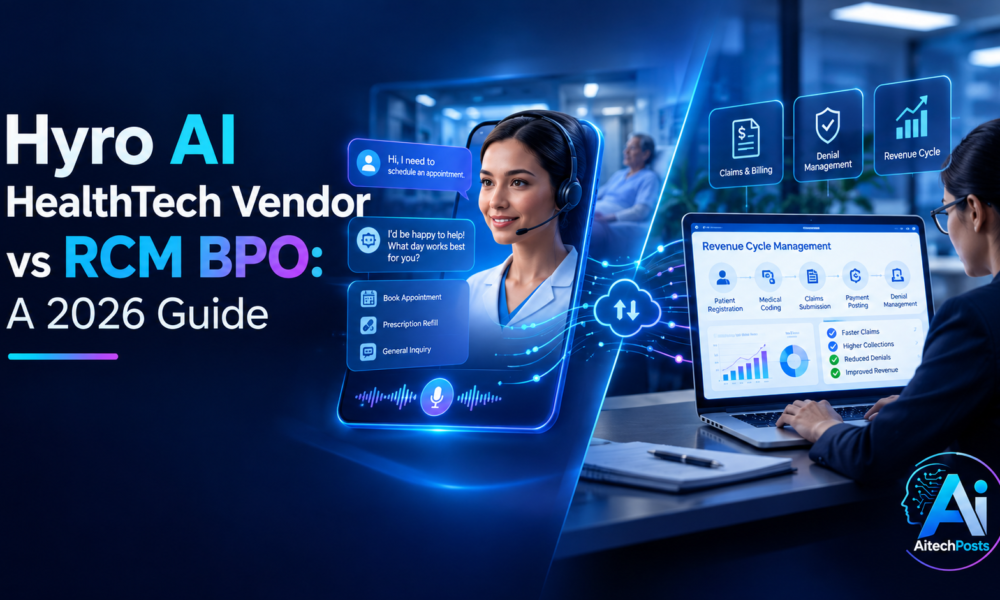
Healthcare organizations are under growing pressure to improve patient access, reduce administrative workload, control operating costs, and make revenue cycle processes more efficient. As a result, many providers are evaluating two very different outsourcing and automation models: AI-powered healthcare technology platforms and traditional revenue cycle management business process outsourcing.
Table Of Content
- Appointment Support
- Frequently Asked Questions
- Patient Navigation
- Contact Center Automation
- Medical Billing
- Coding Support
- Denial Management
- Accounts Receivable Follow-Up
- Payment Processing
- Patient Financial Services
- Q1: What is the main difference between a HealthTech AI vendor and an RCM BPO?
- Q2: Can AI completely replace an RCM BPO?
- Q3: What type of healthcare organization can benefit from conversational AI?
- Q4: What problems does an RCM BPO typically solve?
- Q5: Is AI more scalable than BPO?
- Q6: Can an AI vendor and RCM BPO work together?
- Q7: What should healthcare organizations check before selecting an AI vendor?
That is where the comparison between Hyro AI HealthTech Vendor vs RCM BPO becomes important.
At first glance, the two approaches may appear to solve similar healthcare administration problems. In reality, they operate differently. A HealthTech AI vendor such as Hyro is generally associated with conversational automation designed to handle patient-facing interactions and repetitive administrative workflows. An RCM BPO, on the other hand, relies primarily on outsourced teams, processes, technology, and revenue cycle expertise to perform functions such as billing, coding, claims processing, collections, eligibility verification, and denial management.
For healthcare leaders considering automation or outsourcing in 2026, understanding these differences is essential. The best approach depends on the workflow being improved, the level of human involvement required, integration capabilities, operating costs, compliance requirements, and the organization’s broader digital transformation strategy.
This guide explains the Hyro AI HealthTech Vendor vs RCM BPO comparison in detail.
What Is a HealthTech AI Vendor?
A healthcare AI technology vendor develops software that uses artificial intelligence to automate or enhance clinical and administrative interactions.
In patient access environments, AI systems may support tasks such as appointment-related questions, frequently asked questions, basic navigation, call handling, patient routing, and other repetitive administrative conversations.
Platforms in this category are often designed to work across communication channels such as voice, websites, chat interfaces, and messaging environments.
The central idea is automation.
Instead of assigning every routine request to a human agent, healthcare organizations can use AI to handle predictable interactions automatically while directing more complicated situations to employees.
For example, a patient might contact a healthcare organization to ask about appointment availability, office hours, preparation instructions, or another common administrative matter. An AI-powered conversational system may answer or route that request without requiring a staff member to manage the entire interaction.
That model differs significantly from traditional outsourcing.
What Is an RCM BPO?
RCM stands for Revenue Cycle Management, while BPO means Business Process Outsourcing.
An RCM BPO provider performs some or all revenue-cycle-related activities on behalf of hospitals, physician groups, clinics, health systems, or other healthcare organizations.
These activities can include:
| RCM Function | Typical Responsibility |
|---|---|
| Patient registration | Capturing demographic and insurance details |
| Eligibility verification | Confirming insurance coverage |
| Medical coding | Translating services into billable codes |
| Charge entry | Recording services for billing |
| Claims submission | Sending claims to insurers |
| Payment posting | Recording payer and patient payments |
| Denial management | Investigating and correcting denied claims |
| Accounts receivable | Following unpaid claims |
| Patient billing | Managing patient financial responsibility |
| Revenue reporting | Monitoring financial performance |
Unlike a primarily software-driven AI vendor, an RCM BPO typically combines technology with trained human teams.
The provider may effectively become an extension of the healthcare organization’s billing or administrative department.
Hyro AI HealthTech Vendor vs RCM BPO: The Core Difference
The simplest way to understand the Hyro AI HealthTech Vendor vs RCM BPO comparison is to look at their primary operating models.
A HealthTech AI vendor generally provides technology that automates interactions and workflows.
An RCM BPO generally provides people, processes, operational expertise, and supporting technology to perform outsourced revenue cycle work.
Therefore, the two options should not automatically be viewed as direct substitutes.
They can solve different parts of the healthcare administrative environment.
| Area | HealthTech AI Vendor | RCM BPO |
|---|---|---|
| Primary model | Software automation | Outsourced operations |
| Main resource | AI technology | Human teams + technology |
| Patient interaction | Often strong focus | Depends on service scope |
| Revenue cycle processing | Usually limited or workflow-specific | Core specialization |
| Scaling repetitive requests | High potential | Requires staffing capacity |
| Complex judgment | Human escalation often required | Human specialists manage cases |
| Implementation | Integration-focused | Transition and operational setup |
| Cost structure | Commonly technology/service licensing | Commonly service or transaction-based |
| Main objective | Automate workflows | Perform operational work |
These distinctions are critical when evaluating potential healthcare partners.
How Conversational AI Can Support Healthcare Organizations
One of the strongest use cases for healthcare AI is handling repetitive interactions.
Healthcare call centers and access teams frequently receive large volumes of similar questions. When staff must manually answer every inquiry, the workload can become difficult to manage.
Conversational AI may help automate common requests and make information available outside normal staffing hours.
Typical use cases may include:
Appointment Support
Patients frequently contact providers to schedule, modify, confirm, or ask questions about appointments.
AI-assisted systems can potentially reduce the number of basic requests that require human intervention.
Frequently Asked Questions
Healthcare organizations receive recurring questions about locations, departments, preparation instructions, visiting policies, services, and operating hours.
Automating these inquiries can allow staff members to focus on cases requiring more personal attention.
Patient Navigation
Large health systems can be difficult to navigate.
Conversational interfaces may help users locate departments, services, resources, or appropriate contact points.
Contact Center Automation
Voice-based AI can potentially handle routine incoming conversations or collect information before transferring a patient to a live representative.
This creates a fundamentally different value proposition from an RCM BPO.
The AI system is not necessarily replacing the complete revenue cycle operation. Instead, it may reduce repetitive administrative workload surrounding patient access and communication.
What an RCM BPO Handles Better
Revenue cycle operations involve many processes that extend beyond answering questions.
Claims must be created correctly, documentation must support billing, coding must be accurate, payer requirements must be followed, denials must be investigated, and unpaid accounts require follow-up.
These activities frequently require specialized knowledge and human judgment.
An experienced RCM BPO may support areas such as:
Medical Billing
The provider manages the process of converting healthcare services into claims and submitting them to payers.
Coding Support
Qualified coding professionals can review medical documentation and assign appropriate codes.
Denial Management
Rejected or denied claims may require investigation, correction, supporting documentation, payer communication, or appeals.
Accounts Receivable Follow-Up
Outstanding claims often require ongoing communication with insurance companies.
Payment Processing
Revenue cycle teams may reconcile payments, contractual adjustments, patient responsibility, and payer responses.
Patient Financial Services
Some BPO providers also manage billing questions, statements, payment arrangements, or other financial communications.
These workflows demonstrate why an RCM BPO cannot be reduced to a simple technology product.
Its value is usually tied to operational execution and domain expertise.
Hyro AI HealthTech Vendor vs RCM BPO for Cost Efficiency
Cost is one of the first areas executives evaluate.
However, comparing only the quoted price can be misleading.
An AI platform and an RCM outsourcing agreement may have completely different pricing structures and financial objectives.
A HealthTech AI platform may require expenses related to software licensing, deployment, integration, support, configuration, and ongoing optimization.
An RCM BPO may charge based on collections, transactions, full-time resources, claims volume, service scope, or another commercial structure.
The financial question should therefore be:
What operational cost or workload is each solution designed to reduce?
If an organization has a large volume of repetitive patient inquiries, AI automation may help reduce the cost per interaction.
If an organization lacks internal billing resources or struggles with claims and accounts receivable, an RCM BPO could provide greater operational value.
Cost should be evaluated against the specific process being transformed.
Scalability: AI vs Outsourced Teams
Scalability is another important part of the Hyro AI HealthTech Vendor vs RCM BPO discussion.
Software-based automation can often handle increasing volumes without requiring staff growth at the same rate.
This can be particularly valuable when demand changes unexpectedly.
For example, appointment campaigns, seasonal demand, service disruptions, or public health events may create sudden increases in incoming patient questions.
An AI system may be able to absorb more routine interactions if the workflows have already been configured.
RCM outsourcing scales differently.
Additional transaction volumes may require more operational capacity, process changes, automation, or staffing.
However, the BPO model has an advantage when cases become complicated. Trained specialists can investigate unique problems that are difficult to handle through standardized automation.
Therefore, scalability should not simply be measured by transaction volume. Organizations should also consider workflow complexity.
Integration Requirements
Technology integration can strongly influence the success of healthcare automation.
An AI platform may need to connect with systems such as:
| System | Why Integration Matters |
|---|---|
| EHR | Patient and clinical workflow connectivity |
| Scheduling platform | Appointment availability and changes |
| CRM | Patient communication history |
| Contact center | Voice routing and agent escalation |
| Knowledge base | Accurate organizational information |
| Patient portal | Self-service workflows |
| Authentication systems | Secure access when necessary |
Without strong integration, automation may become another disconnected tool.
RCM BPO integrations can be equally complex.
The outsourced provider may require access to practice management systems, EHR platforms, clearinghouses, payer portals, billing software, documentation, and financial reporting systems.
For both models, technical compatibility should be evaluated before signing a contract.
Human Involvement Remains Important
AI can automate predictable tasks, but healthcare administration contains many exceptions.
A patient may have an unusual scheduling situation. A claim may be denied for a complicated payer-specific reason. Documentation may be incomplete. An insurance policy may require manual verification.
These cases require judgment.
The most practical healthcare operating models therefore combine automation with human escalation.
For conversational AI, the system should have clear rules for transferring sensitive or complex conversations to trained employees.
For RCM outsourcing, technology and automation can support employees while specialists handle situations requiring interpretation or payer interaction.
The real question is not simply AI versus people.
It is how AI and people should work together.
Compliance, Privacy, and Security Considerations
Healthcare organizations should carefully evaluate compliance and security regardless of which model they choose.
Any vendor handling protected health information or accessing healthcare systems may introduce privacy and security considerations.
Healthcare decision-makers should evaluate issues such as data access, encryption, authentication, audit controls, retention practices, subcontractors, business associate agreements when applicable, incident response procedures, and relevant security certifications or assessments.
An RCM BPO may have substantial access to clinical, billing, insurance, and patient financial information.
Similarly, an AI vendor that interacts directly with patients may process sensitive information depending on how the system is configured.
Security evaluation should therefore be part of vendor selection rather than an afterthought.
Implementation Differences
Implementation provides another major distinction in the Hyro AI HealthTech Vendor vs RCM BPO comparison.
Deploying AI generally involves configuring workflows, defining knowledge sources, integrating systems, testing conversations, setting escalation paths, and monitoring performance.
Moving work to an RCM BPO usually involves operational transition.
The healthcare organization may need to transfer processes, provide system access, document standard operating procedures, establish reporting requirements, define service levels, train outsourced teams, and coordinate the transition from internal operations.
Both approaches require preparation, but the nature of the work is different.
How to Measure HealthTech AI Performance
Healthcare organizations should establish measurable objectives before implementing AI.
Relevant metrics can include:
| Metric | What It Shows |
|---|---|
| Automation rate | Percentage of interactions completed without human involvement |
| Containment rate | Requests resolved within the automated channel |
| Transfer rate | Percentage requiring human escalation |
| Response time | How quickly users receive assistance |
| Call deflection | Reduction in calls reaching live agents |
| Patient satisfaction | User experience with automated support |
| Availability | Reliability of the service |
| Error rate | Frequency of incorrect or failed interactions |
Organizations should avoid focusing only on automation volume.
An automated interaction that gives incomplete information does not necessarily represent a successful outcome.
Quality and patient experience matter as much as efficiency.
How to Measure RCM BPO Performance
Revenue cycle outsourcing requires a different set of KPIs.
Important metrics may include:
| Metric | Purpose |
|---|---|
| Clean claim rate | Measures claims submitted successfully without correction |
| Days in A/R | Indicates how quickly payments are collected |
| Denial rate | Tracks payer rejection or denial trends |
| First-pass resolution | Shows claims paid without rework |
| Collection rate | Measures revenue collection effectiveness |
| Coding accuracy | Evaluates coding quality |
| A/R aging | Identifies older unpaid balances |
| Turnaround time | Measures operational speed |
These metrics show why directly comparing an AI platform with an RCM BPO using identical KPIs would be inappropriate.
Each serves a different operational purpose.
When a HealthTech AI Vendor May Be Appropriate
A conversational healthcare AI platform may be worth evaluating when an organization experiences high patient interaction volumes and wants to expand self-service capabilities.
Potential situations include overloaded contact centers, repetitive patient questions, long wait times, high after-hours demand, limited staffing availability, or a desire to offer digital-first communication.
The objective in these cases is generally automation rather than full revenue cycle outsourcing.
When an RCM BPO May Be Appropriate
An RCM BPO may be suitable when the challenge is primarily financial or operational.
Examples can include growing accounts receivable, billing staff shortages, coding backlogs, high denial volumes, inconsistent follow-up, difficulty managing payer requirements, or the need to reduce the administrative burden of billing operations.
Here, the organization is not merely buying technology.
It is transferring responsibility for defined business processes to an external partner.
Can Healthcare Organizations Use Both?
Yes. In many situations, these models can complement one another rather than compete.
Consider a health system that wants to automate patient access while outsourcing portions of its billing operation.
Conversational AI could potentially manage routine appointment and information requests.
Meanwhile, an RCM BPO could manage claims processing, payment posting, denial follow-up, and accounts receivable.
A patient question involving billing might first enter through an automated communication channel and then be routed to the appropriate financial services team when necessary.
This hybrid approach reflects a broader healthcare technology trend: automation handles predictable volume while specialists manage complexity.
Questions to Ask Before Choosing a Vendor
Before deciding between a HealthTech AI platform and an RCM BPO, healthcare leaders should define the actual problem.
Key questions include:
| Question | Why It Matters |
|---|---|
| Which process needs improvement? | Prevents buying the wrong solution |
| Is the challenge patient access or revenue cycle performance? | Determines vendor category |
| How much work is repetitive? | Identifies automation potential |
| How many cases require human judgment? | Determines staffing needs |
| Which systems require integration? | Reveals implementation complexity |
| What patient data will the vendor access? | Supports security assessment |
| How will success be measured? | Establishes performance expectations |
| What happens during escalation? | Protects patient experience |
| Who owns ongoing optimization? | Clarifies responsibilities |
| What is the full cost of implementation? | Avoids incomplete ROI calculations |
These questions create a more useful evaluation framework than simply comparing product features.
Hyro AI HealthTech Vendor vs RCM BPO: Which Model Solves Which Problem?
The strongest conclusion from the Hyro AI HealthTech Vendor vs RCM BPO comparison is that these models address different healthcare challenges.
A HealthTech AI vendor is primarily an automation solution. Its value is generally associated with reducing repetitive interactions, improving self-service, supporting patient access, and allowing employees to focus on more complex work.
An RCM BPO is primarily an operational outsourcing solution. Its value comes from transferring revenue cycle responsibilities to specialized teams supported by technology and structured processes.
Healthcare organizations should therefore avoid framing the decision as simply choosing one over the other.
Instead, they should identify where the operational bottleneck exists.
If the bottleneck is repetitive patient communication, conversational AI may deserve attention.
If the problem lies in billing, claims, denials, collections, or accounts receivable, an RCM BPO may be more relevant.
If both problems exist, a combined approach may be appropriate.
Frequently Asked Questions
Q1: What is the main difference between a HealthTech AI vendor and an RCM BPO?
A: A HealthTech AI vendor primarily provides software-driven automation, while an RCM BPO primarily performs outsourced revenue cycle operations using people, processes, and technology.
Q2: Can AI completely replace an RCM BPO?
A: Not necessarily. RCM includes complex activities such as coding, denial investigation, payer communication, appeals, and accounts receivable management. AI may automate portions of these workflows, but many cases still require specialized human involvement.
Q3: What type of healthcare organization can benefit from conversational AI?
A: Hospitals, health systems, clinics, physician groups, specialty networks, and other organizations dealing with large volumes of repetitive patient interactions may benefit from evaluating conversational AI.
Q4: What problems does an RCM BPO typically solve?
A: RCM BPO providers commonly address billing workload, coding support, claims management, payment posting, denials, accounts receivable follow-up, and patient financial services.
Q5: Is AI more scalable than BPO?
A: AI may scale repetitive digital or voice interactions efficiently because additional volume does not necessarily require proportional staffing growth. BPO operations can also scale, but complex processes may require additional human capacity.
Q6: Can an AI vendor and RCM BPO work together?
A: Yes. A healthcare organization can use AI for patient-facing automation while using an RCM partner for back-office financial operations.
Q7: What should healthcare organizations check before selecting an AI vendor?
A: Organizations should evaluate integrations, security, privacy, workflow accuracy, escalation processes, performance reporting, implementation requirements, vendor support, and total cost.
Conclusion
The Hyro AI HealthTech Vendor vs RCM BPO discussion represents a larger change occurring across healthcare administration in 2026: organizations are deciding which tasks should be automated, which should remain human-led, and which should be outsourced.
The two approaches should not automatically be treated as direct competitors.
Healthcare AI platforms are built around automation and intelligent interaction. RCM BPO providers are built around operational execution and revenue cycle expertise.
The right decision depends on the underlying challenge.
Organizations struggling with repetitive patient interactions may investigate conversational AI. Those facing billing, claims, denial, or collection challenges may investigate RCM outsourcing. Larger healthcare systems may ultimately use both models as part of an integrated operating strategy.
For decision-makers, the most important step is to begin with workflow analysis rather than vendor selection. Identify the problem, determine how much of the work can realistically be automated, calculate the cost of the current process, define measurable outcomes, and evaluate how technology and human expertise can work together.
That framework makes the Hyro AI HealthTech Vendor vs RCM BPO comparison far more useful than simply asking which option is better.








No Comment! Be the first one.