






MDA3201-A Robotic Screwdriver: Features, Uses & Guide
Modern manufacturing depends heavily on consistency, speed, and process control. Even a simple task such as tightening a screw can influence product quality, production efficiency, and long-term...

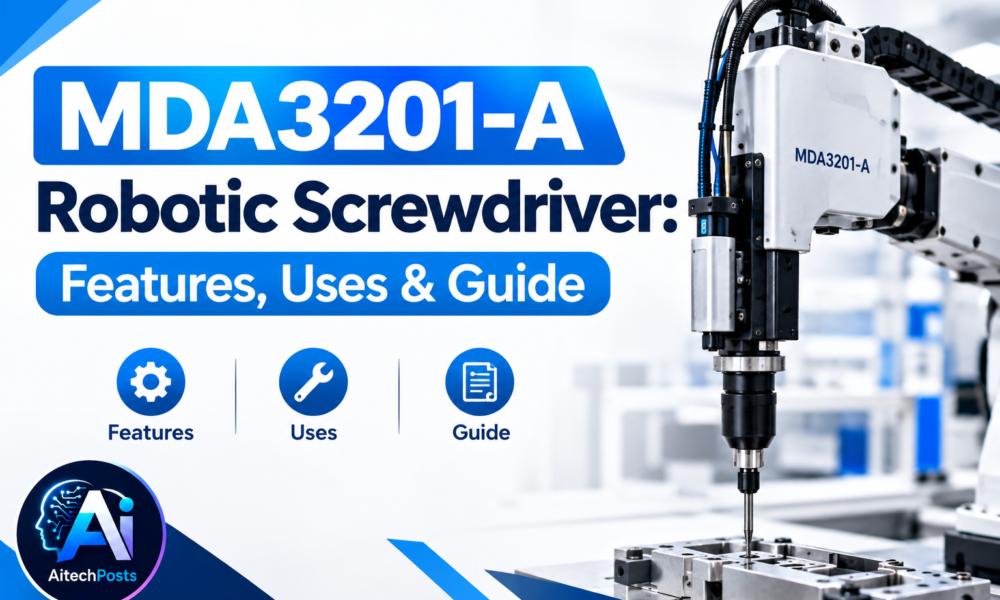
Modern manufacturing depends heavily on consistency, speed, and process control. Even a simple task such as tightening a screw can influence product quality, production efficiency, and long-term reliability. This is why automated fastening equipment has become increasingly important in electronics, machinery, automotive components, electrical products, and precision manufacturing.
Table Of Content
- Precision Torque Control
- Adjustable Speed
- Swiss DC Servo Motor
- Automatic Shut-Off Clutch
- Compact Automation-Friendly Design
- Electronics Assembly
- Small Mechanical Assemblies
- Electrical Equipment Manufacturing
- Robotic Production Cells
- Precision Manufacturing
- Better Fastening Consistency
- Reduced Repetitive Manual Work
- Faster Production Cycles
- Greater Production Flexibility
- Fastening Traceability
The MDA3201-A Robotic Screwdriver is designed specifically for robotic and automated screw-fastening applications. Rather than depending on an operator to manually control every fastening cycle, the screwdriver can become part of an automated production system where tightening speed, torque, process sequences, and fastening results are managed in a more controlled way.
According to Mountz, the MDA3201-A uses a Swiss DC servo motor, operates within an adjustable speed range of 150 to 2,000 RPM, and is designed to work with the MDC-32 controller. Its published torque range is 9.7 to 117.5 cN·m, equivalent to approximately 0.86 to 10.4 lbf·in.
This guide explains the features, operation, uses, advantages, integration requirements, and important considerations associated with the MDA3201-A Robotic Screwdriver.
What Is the MDA3201-A Robotic Screwdriver?
The MDA3201-A Robotic Screwdriver is an electric torque screwdriver engineered for automated and fixtured fastening applications. It is not intended to function like an ordinary handheld screwdriver. Instead, it is designed to become part of a robotic cell, automated assembly station, or machine-controlled fastening process.
The screwdriver uses a 1/4-inch female hex drive and includes a front mounting flange to simplify installation into automated equipment. Mountz lists the MDA3201-A as item number 310048 and specifies that it requires an MDC-32 controller for operation.
The primary purpose of the system is to make repetitive screw fastening more controlled and repeatable. In manufacturing environments, repeating the same fastening task hundreds or thousands of times creates opportunities for inconsistency if torque, speed, or operator technique varies.
The MDA3201-A helps address this problem by allowing fastening parameters to be programmed and integrated into a production process.
How Does the MDA3201-A Robotic Screwdriver Work?
The basic principle behind the MDA3201-A Robotic Screwdriver combines an electric servo motor, torque control, automatic shut-off technology, and an external controller.
During a typical automated fastening operation, a robot, fixture, slide, or machine positions the screwdriver over the screw. The production system then sends a start command to begin the tightening process.
The motor rotates the screwdriver bit according to the programmed speed. As the screw becomes tighter, resistance increases. The screwdriver’s automatic shut-off clutch stops the fastening action when the preset torque condition is reached.
This helps prevent unnecessary continued rotation after the desired tightening level has been achieved.
The MDA3201-A can also operate in forward and reverse directions, while the controller provides start and stop signals that can be incorporated into a larger automated sequence.
In practical terms, an automated cycle may involve positioning the product, presenting a screw, moving the screwdriver into place, running the tightening operation, confirming the result, and moving to the next fastening position.
Key Features of the MDA3201-A Robotic Screwdriver
Precision Torque Control
One of the most important characteristics of the MDA3201-A Robotic Screwdriver is controlled torque delivery.
Mountz specifies a torque range of approximately 9.7 to 117.5 cN·m, or 1 to 12 kgf·cm. This relatively low torque range makes the tool particularly relevant to precision fastening applications where excessive tightening could potentially damage threads, housings, electronic assemblies, or lightweight components.
Correct torque is important because an under-tightened fastener may become loose, while an over-tightened fastener may damage the screw, threaded material, or assembled component.
Adjustable Speed
The MDA3201-A offers an adjustable operating speed ranging from approximately 150 to 2,000 RPM.
Adjustable speed gives manufacturing engineers greater flexibility when developing fastening processes.
A higher speed may be useful during initial screw rundown, while more controlled operation can be important when the screw approaches its final seating position.
The ideal speed depends on screw type, joint design, material, required cycle time, and product sensitivity.
Swiss DC Servo Motor
The screwdriver incorporates a Swiss DC servo motor design. Mountz describes the system as providing accurate and repeatable torque control for automated applications.
Servo-driven tools can be especially useful where repetitive operation and controlled motion are required.
The motor is one part of the overall fastening system, working alongside the clutch, controller, programmed parameters, mounting equipment, and automation hardware.
Automatic Shut-Off Clutch
Another key feature is the precision automatic shut-off clutch.
Once the preset torque level has been achieved, the mechanism stops the tightening cycle rather than continuing to drive the screw unnecessarily.
This feature is important for applications where consistent tightening is more valuable than simply completing the screwdriving operation as quickly as possible.
Compact Automation-Friendly Design
The MDA3201-A Robotic Screwdriver weighs approximately 1.7 pounds and has a published length of around 11 inches. Its grip diameter is approximately 1.5 inches.
Its relatively compact design can make it easier to integrate into automated assembly equipment where available space may be limited.
The front mounting flange also supports fixed or robotic installation.
Role of the MDC-32 Controller
The MDA3201-A Robotic Screwdriver does not operate as a completely independent tool. It requires an MDC-32 controller.
The controller is an important part of the fastening system because it provides the programming, communication, process management, and data functions needed in automated production.
According to Mountz, the MDC controller can store up to 30 process sequences with as many as 20 program steps. It can also collect fastening data and save it to an SD memory card.
This becomes useful when a production line contains several fastening conditions.
For example, one product may contain screws requiring different operating parameters. Instead of using a separate screwdriver for every condition, a programmable system may allow different fastening sequences to be handled through controlled programs, provided all applications remain within the tool’s mechanical and torque capabilities.
The controller also provides digital I/O communication for external devices such as programmable logic controllers, commonly known as PLCs.
This makes integration possible with robots, sensors, fixtures, conveyors, screw feeders, and other manufacturing equipment.
Main Uses of the MDA3201-A Robotic Screwdriver
Electronics Assembly
Electronics manufacturing frequently involves relatively small fasteners and delicate housings.
The MDA3201-A Robotic Screwdriver may be suitable for certain electronic assembly operations where controlled low-torque fastening is required.
Applications could include compatible circuit-related housings, control devices, electronic modules, small enclosures, and similar assemblies.
However, engineers should always verify that the required torque falls within the tool’s specified operating range before integration.
Small Mechanical Assemblies
Many small mechanical products contain multiple screws that need to be tightened consistently.
Automated screwdriving can reduce variation between fastening cycles while also decreasing the amount of repetitive manual work required from operators.
Where the torque requirements match its specifications, the MDA3201-A can be incorporated into automated mechanical assembly systems.
Electrical Equipment Manufacturing
Electrical switches, control modules, small electrical enclosures, connectors, and related components can involve repeated fastening tasks.
Consistent tightening can be particularly important where assembly quality depends on maintaining uniform fastening conditions across large production volumes.
Robotic Production Cells
The MDA3201-A Robotic Screwdriver is specifically designed for robotic and automated torque applications.
It can therefore be mounted into a production cell where a robot or automated positioning mechanism moves either the screwdriver or the workpiece.
The combination of programmable operation and I/O communication allows the screwdriver system to become one stage within a larger manufacturing process.
Precision Manufacturing
Precision assemblies often require better control than basic manual screwdriving can provide.
By combining a controlled torque range, programmable speed, and automatic shut-off functionality, the MDA3201-A can support suitable applications where minimizing fastening variation is important.
Benefits of the MDA3201-A Robotic Screwdriver
Better Fastening Consistency
Consistency is one of the biggest reasons manufacturers introduce automated screwdriving.
Manual workers can perform fastening tasks accurately, but repetitive production naturally introduces differences in technique, speed, positioning, and tool handling.
An automated system follows programmed conditions, helping manufacturers create a more repeatable fastening process.
Reduced Repetitive Manual Work
Screw installation can become physically repetitive when workers perform the same operation throughout a production shift.
Automated fastening can reduce direct operator involvement in repetitive screwdriving operations, allowing workers to concentrate on inspection, material handling, machine supervision, or other higher-value tasks.
Faster Production Cycles
Manufacturing productivity often depends on reducing unnecessary movement and process variation.
Mountz states that its robotic screwdriver systems are designed to help reduce production cycles and improve automation efficiency.
Actual production improvement, however, depends on the complete system, including robot speed, screw feeding, workpiece positioning, fixtures, and process programming.
Greater Production Flexibility
The MDC-32 controller can support multiple programmed sequences.
This can make production systems easier to reconfigure when compatible products require different fastening procedures.
Mountz notes that programmable configurations may allow one tool to perform tasks that otherwise could require multiple conventional tools, provided the applications remain within the screwdriver’s operating limits.
Fastening Traceability
Modern manufacturers increasingly need to document production processes.
The MDC-32 can collect and store fastening information and provides analysis features for torque-related production data.
This can assist manufacturers that want better process monitoring, production records, quality verification, or troubleshooting information.
MDA3201-A Robotic Screwdriver vs Manual Screwdriving
The biggest difference between robotic and manual screwdriving is not simply speed.
It is process control.
A manual fastening process depends more heavily on the operator and the type of hand tool being used. A robotic fastening system can execute predefined operations repeatedly with less variation in movement and timing.
The MDA3201-A Robotic Screwdriver also offers programmable speed, controller-based process sequences, data collection, and communication with external automation devices.
That does not mean automated screwdriving is always superior.
Manual tools can remain practical for repair operations, low-volume manufacturing, prototyping, changing product designs, and applications where maximum flexibility is more important than automation.
The MDA3201-A becomes more relevant when production volumes, repeatability, integration, traceability, and cycle control become priorities.
What Should You Consider Before Using the MDA3201-A?
The first factor is required torque.
Your fastening application should fall safely within the specified operating range of the MDA3201-A Robotic Screwdriver.
Engineers should also consider screw dimensions, thread design, material hardness, joint type, target clamp force, bit compatibility, cycle time, and required fastening accuracy.
The next consideration is automation architecture.
The screwdriver needs to work with the MDC-32 controller, and the complete setup may also require suitable cables, mounting equipment, I/O connections, screw presentation equipment, vacuum adapters, or other automation components. Mountz lists screw presenters, vacuum adapters, I/O cables, wiring equipment, and related accessories for its robotic fastening systems.
It is also important to consider maintenance.
Screwdriver bits, cables, mounting systems, screw feeders, sensors, and mechanical fixtures should be inspected regularly. A fastening system can only remain consistent when its supporting equipment is also operating correctly.
Can the MDA3201-A Handle Different Fastening Programs?
Yes, within its specified limits.
Because the MDA3201-A works with the programmable MDC-32 controller, multiple process sequences can be configured for suitable applications.
This can be useful when a product contains different fastening points or when the same production cell handles more than one product configuration.
However, programming flexibility does not eliminate mechanical limits.
Every screwdriving operation must still remain within the screwdriver’s supported torque, speed, drive, and operating requirements.
Does the MDA3201-A Work Without the MDC-32?
No.
Mountz specifically states that the MDA3201-A Robotic Screwdriver requires the MDC-32 controller.
Manufacturers planning an installation should therefore evaluate the screwdriver and controller as parts of a complete fastening system rather than treating the screwdriver as a stand-alone tool.
Depending on the automation design, additional hardware may also be necessary.
Conclusion
The MDA3201-A Robotic Screwdriver is a precision electric fastening tool designed for robotic, automated, and fixtured assembly applications.
Its combination of adjustable speeds from 150 to 2,000 RPM, a torque range of approximately 9.7 to 117.5 cN·m, automatic shut-off technology, a Swiss DC servo motor, programmable operation, and compatibility with the MDC-32 controller makes it suitable for carefully controlled fastening applications.
Its real advantage is not simply the ability to turn screws automatically. The system allows screw fastening to become a programmable, repeatable, monitorable, and better-documented manufacturing process.
For manufacturers considering the MDA3201-A Robotic Screwdriver, the most important step is to compare the actual assembly requirements with the tool’s torque range, speed capabilities, controller requirements, fastening materials, automation equipment, and desired production cycle.
When properly matched to the application, the MDA3201-A can support consistent fastening, reduced repetitive manual work, production flexibility, improved process monitoring, and efficient integration into modern automated assembly environments.








No Comment! Be the first one.