






How Omniflow AI Simplifies Complex Business Workflows
Introduction: How Omniflow AI Is Changing Business Automation Omniflow AI! Businesses today operate in an increasingly complex digital environment. Teams manage multiple software platforms, customer...

Introduction: How Omniflow AI Is Changing Business Automation
Omniflow AI! Businesses today operate in an increasingly complex digital environment. Teams manage multiple software platforms, customer interactions, operational tasks, data analysis, communication channels, and repetitive processes every day. While technology has improved productivity, managing disconnected systems and complicated workflows remains a major challenge for many organizations.
Table Of Content
- Introduction: How Omniflow AI Is Changing Business Automation
- Increasing Business Complexity
- Growing Data Volumes
- Need for Faster Decisions
- 1. Automating Repetitive Tasks
- AI-Powered Automation
- Workflow Management
- Data Analysis and Insights
- Smart Integration
- Predictive Capabilities
- Healthcare Industry
- Increased Productivity
- Reduced Operational Costs
- Improved Accuracy
- Better Collaboration
- Faster Business Growth
- Data Security
- Integration Complexity
- Employee Adoption
- Maintaining Human Oversight
- AI Agents
- Hyper-Personalized Automation
- More Connected Digital Ecosystems
- Human and AI Collaboration
- Q1: What is Omniflow AI?
- Q2: How does Omniflow AI improve business workflows?
- Q3: Can small businesses use Omniflow AI?
- Q4: What industries can benefit from Omniflow AI?
- Q5: Is AI workflow automation replacing employees?
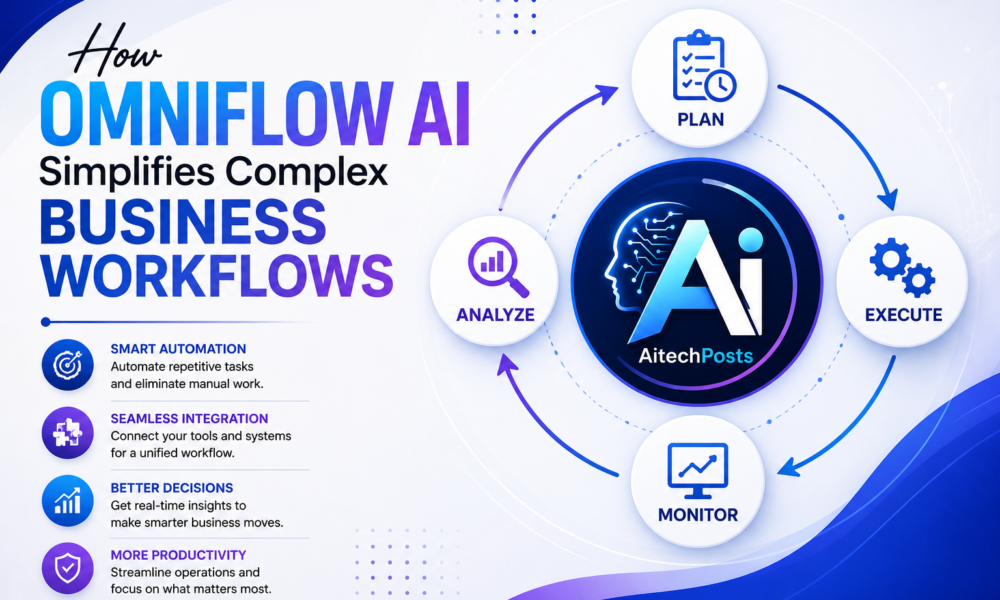
This is where Omniflow AI is gaining attention as a modern approach to simplifying business workflows. By combining artificial intelligence, automation, data processing, and intelligent decision-making, Omniflow AI helps organizations streamline operations, reduce manual work, and create more efficient processes.
Unlike traditional automation tools that depend on fixed rules, AI-powered workflow solutions can analyze information, understand patterns, and support smarter business decisions. This allows companies to automate complex processes while maintaining flexibility and improving productivity.
In this article, we will explore how Omniflow AI simplifies complex business workflows, its key features, applications, benefits, challenges, and how AI-driven automation is shaping the future of business operations.
What Is Omniflow AI?
Omniflow AI refers to an AI-powered workflow automation approach designed to help businesses manage complex processes through intelligent automation.
Modern organizations often use multiple systems for different activities, including:
-
Customer relationship management (CRM)
-
Marketing platforms
-
Financial software
-
Communication tools
-
Project management systems
-
Data analytics platforms
Managing these systems manually can create delays, errors, and unnecessary workload.
Omniflow AI focuses on connecting business processes and making workflows more intelligent. Instead of employees spending hours performing repetitive tasks, AI systems can help automate operations, analyze information, and provide recommendations.
The main objective of Omniflow AI is to create smoother business operations by allowing technology to handle repetitive and complicated processes while employees focus on strategic work.
Why Businesses Need AI Workflow Automation
Before understanding how Omniflow AI works, it is important to understand why companies are moving toward intelligent workflow automation.
Increasing Business Complexity
Businesses now operate across multiple digital channels.
A single company may need to manage:
-
Online customers
-
Social media communication
-
Sales pipelines
-
Employee collaboration
-
Financial reporting
-
Data security
As operations become more complex, traditional manual processes become inefficient.
Growing Data Volumes
Every business generates large amounts of data.
Examples include:
-
Customer information
-
Sales records
-
Website activity
-
Market trends
-
Employee performance data
Manually analyzing this information is time-consuming.
AI-powered workflow systems help businesses process data faster and identify useful insights.
Need for Faster Decisions
Markets change quickly, and companies need real-time information to respond effectively.
AI automation helps organizations:
-
Identify trends
-
Predict outcomes
-
Detect problems
-
Recommend actions
This improves decision-making speed and accuracy.
How Omniflow AI Simplifies Complex Business Workflows
1. Automating Repetitive Tasks
One of the biggest advantages of Omniflow AI is reducing repetitive manual work.
Many business processes involve routine tasks such as:
-
Data entry
-
Email responses
-
Report generation
-
Scheduling
-
Document processing
Employees often spend significant time completing these activities.
With AI-powered automation, businesses can create workflows where these tasks are completed automatically.
For example:
A sales team can use AI automation to organize leads, update customer records, and generate follow-up reminders without manual effort.
This improves productivity and reduces human errors.
2. Connecting Multiple Business Systems
Many companies struggle because their software systems operate separately.
For example:
-
Marketing tools store customer data
-
Sales platforms manage leads
-
Accounting systems track payments
-
Support platforms handle customer issues
Without integration, employees must manually transfer information between systems.
Omniflow AI simplifies workflows by creating connections between different platforms.
This allows information to move smoothly across departments.
Benefits include:
-
Faster communication
-
Reduced duplicate work
-
Better data accuracy
-
Improved collaboration
3. Using AI for Intelligent Decision-Making
Traditional automation follows predefined instructions.
AI-powered automation goes further by analyzing situations and recommending actions.
Omniflow AI can support decision-making by helping businesses understand:
-
Customer behavior
-
Operational performance
-
Market trends
-
Workflow problems
For example:
An AI system may identify that customer response times are increasing and suggest workflow improvements.
This allows businesses to solve problems before they become major issues.
4. Improving Workflow Efficiency
Complex workflows often contain unnecessary steps.
AI technology can analyze business processes and identify areas where improvements are possible.
Omniflow AI helps organizations optimize workflows by:
-
Removing unnecessary manual steps
-
Automating approval processes
-
Improving communication
-
Reducing delays
The result is a faster and more efficient operational structure.
5. Enhancing Customer Experience
Customer expectations are higher than ever.
People expect:
-
Quick responses
-
Personalized communication
-
Smooth service experiences
Omniflow AI helps businesses improve customer interactions through intelligent automation.
Possible applications include:
-
AI-powered customer support
-
Automated recommendations
-
Personalized marketing messages
-
Faster issue resolution
By improving customer experiences, businesses can increase satisfaction and loyalty.
Key Features of Omniflow AI
AI-Powered Automation
The core feature of Omniflow AI is intelligent automation.
Unlike simple automation tools, AI-powered systems can analyze information and adjust workflows based on changing conditions.
Workflow Management
Businesses can design and manage complex workflows without requiring extensive technical knowledge.
Workflow management helps teams:
-
Organize tasks
-
Assign responsibilities
-
Monitor progress
-
Improve efficiency
Data Analysis and Insights
Data is essential for modern business decisions.
Omniflow AI helps transform business data into meaningful insights.
Organizations can use these insights to:
-
Improve strategies
-
Identify opportunities
-
Reduce inefficiencies
Smart Integration
Modern businesses rely on many digital platforms.
AI workflow systems help connect these tools to create a unified business environment.
Integration improves:
-
Information sharing
-
Automation capabilities
-
Team productivity
Predictive Capabilities
One of the most powerful aspects of AI is prediction.
AI systems can analyze historical information and identify possible future outcomes.
Businesses can use predictive capabilities for:
-
Sales forecasting
-
Customer behavior analysis
-
Resource planning
-
Risk management
Omniflow AI Use Cases Across Industries
Healthcare Industry
Healthcare organizations manage complex workflows involving:
-
Patient records
-
Appointment scheduling
-
Medical documentation
-
Administrative processes
AI automation can help healthcare providers improve efficiency and reduce administrative workload.
Potential benefits include:
-
Faster data processing
-
Improved patient communication
-
Better resource management
Financial Services
Financial companies handle large amounts of sensitive information.
Omniflow AI can support:
-
Document processing
-
Fraud monitoring
-
Customer service automation
-
Financial analysis
AI helps financial organizations improve accuracy and operational speed.
Retail and E-commerce
Retail businesses need to manage:
-
Customer interactions
-
Inventory
-
Marketing campaigns
-
Sales analytics
AI workflow automation helps retailers create personalized customer experiences and improve operational efficiency.
Marketing Agencies
Marketing teams manage multiple campaigns, platforms, and customer data.
Omniflow AI can assist with:
-
Campaign automation
-
Customer segmentation
-
Performance analysis
-
Reporting
This allows marketers to focus more on strategy and creativity.
Manufacturing
Manufacturing companies require efficient processes across production, supply chain, and quality control.
AI workflow solutions can help with:
-
Production monitoring
-
Predictive maintenance
-
Inventory management
-
Operational optimization
Benefits of Omniflow AI for Businesses
Increased Productivity
Automation allows employees to spend less time on repetitive tasks and more time on important business activities.
Reduced Operational Costs
By improving efficiency and reducing manual processes, companies can lower operational expenses.
Improved Accuracy
AI automation reduces human errors in data processing and workflow management.
Better Collaboration
Connected workflows allow different departments to share information more effectively.
Faster Business Growth
Efficient workflows allow companies to scale operations without increasing complexity.
Omniflow AI vs Traditional Workflow Automation
| Traditional Automation | Omniflow AI Approach |
|---|---|
| Rule-based processes | Intelligent decision-making |
| Limited flexibility | Adaptive workflows |
| Manual monitoring | AI-supported optimization |
| Separate systems | Connected platforms |
| Reactive approach | Predictive insights |
The difference is that AI-powered workflows can understand situations and improve over time.
Challenges of Implementing AI Workflow Solutions
Although AI workflow automation offers many advantages, businesses should consider several challenges.
Data Security
AI systems often process sensitive business information.
Companies need strong security practices to protect data.
Integration Complexity
Connecting AI systems with existing business software may require planning and technical support.
Employee Adoption
Teams may need training to understand and effectively use AI-powered tools.
Maintaining Human Oversight
AI should support human decision-making rather than completely replace human judgment.
The Future of AI-Powered Business Workflows
The future of business automation will increasingly depend on artificial intelligence.
Several trends are shaping the next generation of workflow solutions.
AI Agents
AI agents are becoming more advanced and capable of completing complex tasks independently.
Future workflow systems may handle entire business processes automatically.
Hyper-Personalized Automation
AI will enable businesses to create workflows customized for specific customers, employees, and operational needs.
More Connected Digital Ecosystems
Businesses will continue integrating their tools into unified intelligent systems.
Human and AI Collaboration
The future will focus on collaboration between people and AI.
Employees will use AI as a productivity partner to make better decisions and complete work faster.
Frequently Asked Questions About Omniflow AI
Q1: What is Omniflow AI?
A: Omniflow AI is an AI-powered workflow automation approach designed to simplify complex business processes through intelligent automation and data-driven decision-making.
Q2: How does Omniflow AI improve business workflows?
A: Omniflow AI improves workflows by automating repetitive tasks, connecting systems, analyzing data, and providing intelligent insights.
Q3: Can small businesses use Omniflow AI?
A: Yes, AI workflow automation can benefit businesses of different sizes by improving productivity and reducing operational complexity.
Q4: What industries can benefit from Omniflow AI?
A: Industries including healthcare, finance, retail, marketing, and manufacturing can benefit from AI-powered workflow solutions.
Q5: Is AI workflow automation replacing employees?
A: AI workflow automation is mainly designed to support employees by reducing repetitive work and improving productivity.
Conclusion
Omniflow AI simplifies complex business workflows by combining artificial intelligence, automation, data analysis, and intelligent decision-making. As organizations continue facing increasing operational complexity, AI-powered workflow solutions provide a practical way to improve efficiency and create smoother digital processes.
From automating repetitive tasks to connecting business systems and generating valuable insights, Omniflow AI represents the future direction of modern business automation.
Companies that successfully adopt intelligent workflow technologies can improve productivity, reduce costs, and create better experiences for both employees and customers. As AI continues evolving, solutions like Omniflow AI will play an increasingly important role in helping businesses operate smarter and faster.







No Comment! Be the first one.