






Python static method example: Syntax, Uses, and Examples
Introduction Python is one of the most popular programming languages because of its simplicity, flexibility, and powerful object-oriented programming features. When working with classes and objects...

Introduction
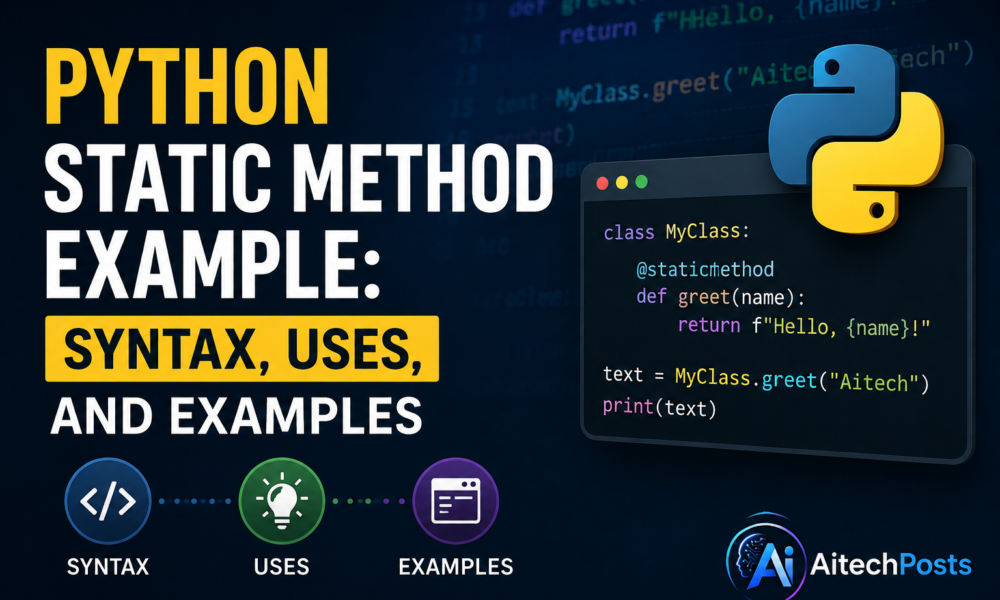
Python is one of the most popular programming languages because of its simplicity, flexibility, and powerful object-oriented programming features. When working with classes and objects in Python, developers often use different types of methods to organize and manage their code effectively. Among these methods, the Python static method example is an important concept that helps developers create utility functions related to a class without depending on class or object data.
Table Of Content
- Difference Between Instance Methods, Class Methods, and Static Methods
- Instance Methods
- Class Methods
- Static Methods
- Example 1: Product Price Calculation
- Example 2: Date Validation
- Example 3: Data Formatting
- 1. Better Code Organization
- 2. Improved Readability
- 3. No Need for Object Creation
- 4. Better Code Reusability
- Static Methods and Object-Oriented Programming in Python
- Treating Static Methods Like Instance Methods
- Using Static Methods Everywhere
- Creating Unnecessary Classes
- Keep Methods Focused
- Use Clear Naming
- Keep Logical Relationships
- Avoid Unnecessary Complexity
- Q1: What is a Python static method?
- Q2: Why use static methods in Python?
- Q3: Can a static method access class variables?
- Q4: Can static methods accept arguments?
- Q5: Are static methods faster than normal methods?
- Q6: Should every utility function be a static method?
Understanding a Python static method example makes it easier to learn how Python handles methods inside classes and when a static method should be used instead of regular instance methods or class methods.
Unlike normal methods that work with object-specific information, static methods perform independent tasks that are logically connected to a class. They are useful when a function belongs to a class conceptually but does not need access to instance variables or class variables.
In this article, we will explore what a static method is in Python, understand its syntax, learn when to use it, discuss its advantages, and look at practical examples explained without code.
What Is a Static Method in Python?
A static method in Python is a method that belongs to a class but does not require access to the object or the class itself. It behaves like a regular function but is placed inside a class because it has a logical relationship with that class.
Normally, methods inside a Python class are designed to work with object data. These methods receive information about the current object and can access attributes stored inside that object. However, sometimes a function does not need any object-related information but still makes sense to keep inside a particular class.
This is where a static method becomes useful.
A Python static method example usually represents a situation where a function performs a specific operation related to a class but works independently. It can receive arguments, process information, and return results without interacting with class properties.
For example, imagine a class related to employees. A function that checks whether an employee ID follows a specific format may be connected to the employee concept, but it does not need information from a particular employee object. Such functionality can be designed as a static method.
Why Are Static Methods Used in Python?
Static methods are mainly used to organize related functionality inside a class structure. Instead of creating separate functions everywhere in a project, developers can group related operations together.
Some common reasons to use static methods include:
- Organizing helper functions inside relevant classes
- Improving code structure and readability
- Creating utility functions that do not depend on object data
- Keeping related operations in one logical location
- Avoiding unnecessary object creation
A class often represents a specific concept, and static methods allow developers to add useful operations related to that concept without forcing those operations to depend on class data.
For example, a mathematics-related class may contain functions for calculations. These functions may not require information from a particular object, but keeping them inside the class can make the program easier to understand.
Python Static Method Syntax Explained
The syntax of a Python static method is simple compared to many other object-oriented programming concepts.
A static method is created inside a class and is marked as a static method using a built-in Python feature called a decorator.
The important thing to understand is that a static method does not automatically receive information about the object or the class.
Regular instance methods work with object information, while class methods work with class-level information. Static methods work independently.
The general structure includes:
- A class that contains the method
- A static method declaration
- Parameters required for the task
- Logic that performs the required operation
Because static methods do not depend on object or class information, they are often similar to normal functions. The main difference is their placement inside a class.
Difference Between Instance Methods, Class Methods, and Static Methods
Python provides three major types of methods inside classes:
- Instance methods
- Class methods
- Static methods
Understanding the difference between these methods is important for choosing the correct approach.
Instance Methods
Instance methods are the most common type of methods in Python classes. They work with individual objects and can access object-specific information.
For example, if a class represents a customer, an instance method can access details such as customer name, account information, or preferences.
Instance methods are useful when the operation depends on a specific object.
Class Methods
Class methods work with class-level information rather than individual objects. They are useful when an operation needs to access or modify information shared by all objects of a class.
For example, a class method may track how many objects have been created from a particular class.
Static Methods
Static methods do not require object data or class data. They perform a task that is related to the class.
A Python static method example is useful when a function belongs conceptually to a class but does not need information from that class.
Python Static Method Example Explained in Real-Life Situations
To better understand static methods, consider practical examples.
Example 1: Product Price Calculation
Imagine an online shopping application with a product-related class.
A function that calculates a discount percentage may not require information about a specific product object. It only needs the price and discount rules.
Instead of making it a normal object method, developers can keep it as a static method because it performs a general calculation related to products.
Example 2: Date Validation
A user management system may need to verify whether a date format is correct.
The validation process does not depend on a specific user object. It simply checks whether the provided date follows the required format.
This type of functionality is suitable for a static method.
Example 3: Data Formatting
Applications often need functions that convert data into a specific format.
For example, converting text into a standard format or preparing information before displaying it can be handled through static methods when no class information is required.
Advantages of Using Static Methods in Python
Using static methods provides several benefits when designing Python applications.
1. Better Code Organization
Static methods help keep related functionality together. Instead of placing utility functions separately, developers can group them with the class they belong to.
This improves project structure and makes code easier to maintain.
2. Improved Readability
When developers see a static method inside a class, they immediately understand that the function is related to that class but does not depend on object data.
This makes the purpose of the function clearer.
3. No Need for Object Creation
Static methods can be accessed without creating an object of the class.
This makes them useful for simple operations where creating an object would be unnecessary.
4. Better Code Reusability
Static methods can be reused in different parts of an application because they do not depend on specific object states.
Developers can call them whenever the required functionality is needed.
When Should You Use a Static Method in Python?
A static method should be used when:
- The function does not need information from an object
- The function does not need class-level data
- The function performs a general operation related to the class
- Keeping the function inside the class improves organization
Before creating a static method, developers should ask:
“Does this function need access to the object or class?”
If the answer is no, a static method may be the right choice.
When Should You Avoid Using Static Methods?
Although static methods are useful, they are not suitable for every situation.
Avoid using static methods when:
- The function needs object-specific information
- The function needs to modify object attributes
- The function needs access to class-level variables
- The function represents behavior specific to an object
Using a static method unnecessarily can make the design less clear.
For example, if a function needs customer details to act, it should usually be an instance method instead.
Static Methods and Object-Oriented Programming in Python
Python supports object-oriented programming principles such as encapsulation, inheritance, and abstraction.
Static methods support these principles by allowing developers to organize related behavior within classes.
Although static methods do not directly interact with objects, they still help create cleaner class structures.
In large applications, proper organization becomes extremely important. Static methods can reduce unnecessary complexity by separating independent operations from object-related behavior.
Common Mistakes When Using Static Methods
Many beginners make mistakes when learning static methods in Python.
Treating Static Methods Like Instance Methods
A common mistake is expecting a static method to access object information automatically.
Static methods do not know anything about the object that contains them.
Using Static Methods Everywhere
Some developers use static methods for every function inside a class. This can reduce the benefits of object-oriented programming.
Methods should be selected based on their purpose.
Creating Unnecessary Classes
A static method should have a meaningful relationship with the class. Creating a class only to store unrelated static methods may make the application harder to understand.
Python Static Method Example: Best Practices
To use static methods effectively, follow these best practices:
Keep Methods Focused
A static method should perform one specific task. Avoid creating large methods that handle multiple responsibilities.
Use Clear Naming
The name of a static method should clearly explain what it does.
Keep Logical Relationships
Only place static methods inside classes where they make conceptual sense.
Avoid Unnecessary Complexity
If a normal function works better, there is no need to force it into a class as a static method.
Static Method vs Normal Function
A common question among Python developers is:
“What is the difference between a static method and a normal function?”
The main difference is organization and relationship.
A normal function exists independently, while a static method belongs to a class.
If a function is closely related to a class concept, placing it inside the class as a static method can improve structure.
However, if the function has no connection to any class, a normal function may be a better choice.
How Static Methods Improve Python Application Design
Good software design is not only about making programs work. It is also about making them easy to understand, modify, and expand.
Static methods contribute to better application design by:
- Separating independent operations
- Reducing unnecessary dependencies
- Improving class organization
- Making reusable functions easier to locate
When used correctly, static methods make Python projects cleaner and more professional.
Frequently Asked Questions About Python Static Method Example
Q1: What is a Python static method?
A: A Python static method is a method inside a class that does not require access to object data or class data. It works independently while remaining logically connected to the class.
Q2: Why use static methods in Python?
A: Static methods are used to organize related functions inside classes when those functions do not need object or class information.
Q3: Can a static method access class variables?
A: No, static methods cannot directly access class variables because they do not receive information about the class automatically.
Q4: Can static methods accept arguments?
A: Yes, static methods can accept arguments like normal functions and perform operations using the provided information.
Q5: Are static methods faster than normal methods?
A: The performance difference is usually minimal. The main purpose of static methods is better organization and design rather than speed improvement.
Q6: Should every utility function be a static method?
A: No. A utility function should become a static method only when it has a clear relationship with a class.
Conclusion
Understanding a Python static method example is essential for anyone learning Python object-oriented programming. Static methods provide a clean way to organize functions that belong conceptually to a class but do not require access to object or class information.
They are useful for calculations, validations, formatting tasks, and other independent operations connected to a specific class concept.
By knowing when to use static methods, how they differ from instance methods and class methods, and what advantages they provide, developers can create cleaner, more organized, and maintainable Python applications.
A good understanding of static methods helps programmers write better Python code and design classes that follow professional programming practices.







No Comment! Be the first one.